Practice loan without collateral: up to €750,000 for doctors and liberal professions
Doctors, dentists, pharmacists and other liberal professionals can obtain a business loan without a land charge. The bank’s simplified assessment requires fewer documents, so disbursement can be faster than for a loan secured by property. We do not promise a timeframe: it depends on the bank and the completeness of your documents.
Practice loan without a land charge: how does it work?
Doctors and other liberal professionals who have been self-employed for at least two full calendar years can obtain a business loan of EUR 20,000 to 750,000 through our partner bank, with no land charge and no other collateral. The bank uses a simplified review: profit statement, current management accounts and the self-disclosure form are usually enough.
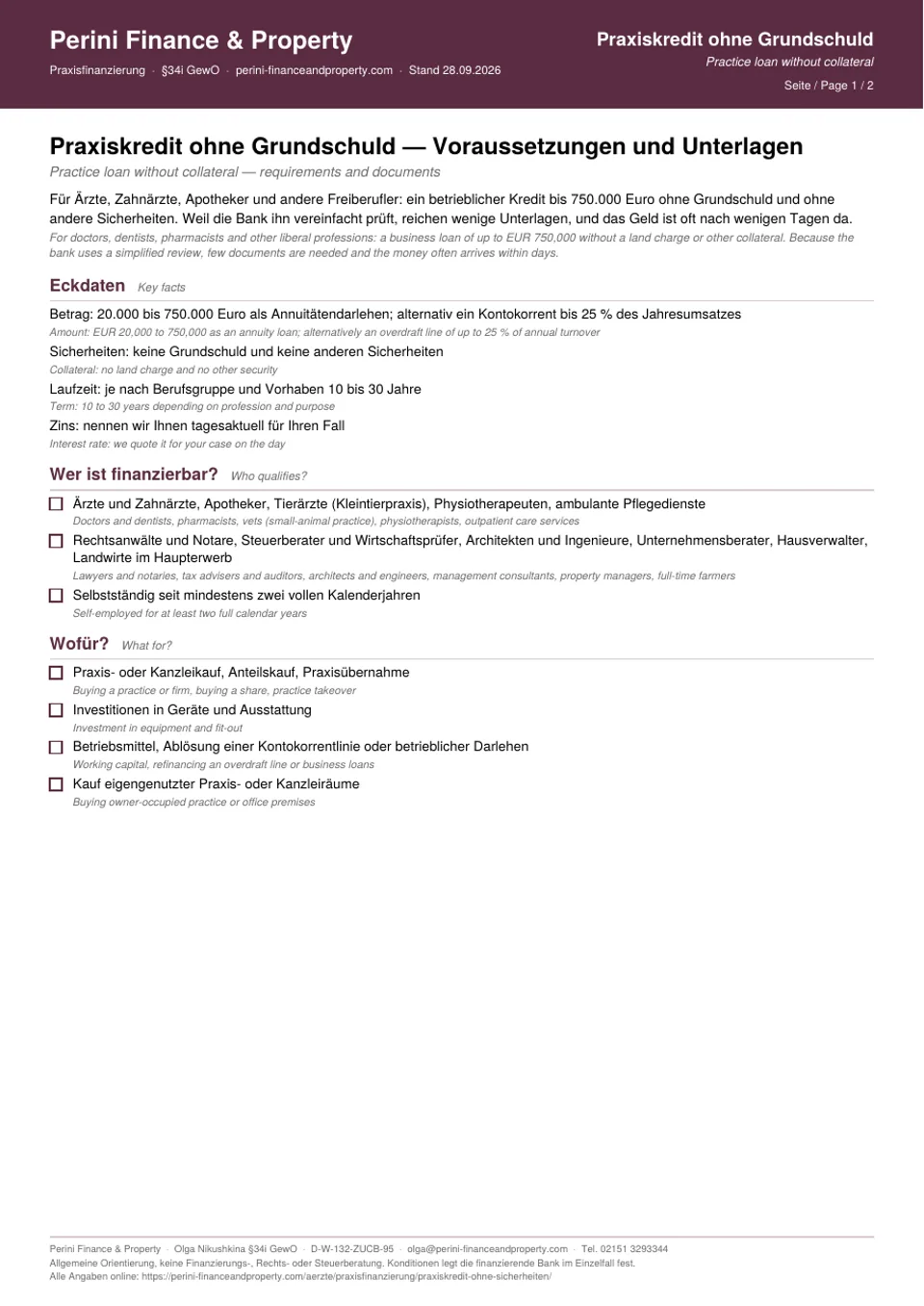
Practice loan PDF: eligibility and document checklist
- Practice loan checklist · key facts, requirements and all documents to tick off
- German and English · for you and your tax adviser
Request by email: Practice loan without collateral — requirements and documents (PDF, 2 pages) (Dutch (praktijklening))
Request the checklist
Free · 30 seconds · no sales pressure
We use your email address to send the files you request. If needed, we may contact you personally about your request.
Who can apply for a practice loan without collateral?
According to the partner bank, eligible applicants include doctors, dentists, pharmacists, vets with small animal practices, physiotherapists, outpatient care services and other freelance professionals. They must have been self-employed for at least two full calendar years.
- Who can apply for the loan? Doctors, dentists, pharmacists, vets with small animal practices, physiotherapists, outpatient care services and other freelance professionals, self-employed for at least two full calendar years.
- What is it intended for? Purchase of a practice or of shares, equipment and fittings, working capital, the repayment of business loans and owner-occupied practice premises.
- How quickly does it work? Because the bank does not have to register a land charge and only checks a few documents, the payout can be quicker than with a loan secured by a land charge. We do not promise a timeframe; it depends on the bank and on whether your documents are complete.
The loan is intended for freelance professionals and some related occupations. The partner bank requires at least two full calendar years of self-employment.
Healthcare professions — Doctors and dentists, pharmacists, vets (small animal practices only), physiotherapists, outpatient care services.
Advisory professions — Lawyers and notaries, tax advisers and auditors, management consultants.
Planning and administrative professions — Architects and engineers, property managers.
Agriculture — Full-time farmers.
The two-year limit is a condition of the banking partner, not a legal requirement.
Those who do not meet it have other options.
Under the ERP StartGeld start-up loan (KfW 067), up to €200,000 per project is possible, of which up to €80,000 for working capital, with an 80 % exemption from liability for the financing partner.
The application must be submitted before the project begins, and standard bank collateral must still be provided (information sheet as at 18 June 2026).
For larger projects, KfW 077 may be an option.
It finances up to €500,000 per applicant and at most 35 % of the eligible costs, and requires a 100 % guarantee from the Bürgschaftsbank (information sheet as at 10 December 2025).
According to Bürgschaftsbank NRW, a classic guarantee from Bürgschaftsbank NRW covers 50 to 80 %, up to €2.0 million (as at 4 October 2026).
More under Bürgschaftsbank.
What can the practice loan be used for?
According to the partner bank, you can use the loan to buy a practice or firm, invest in the business, fund working capital, refinance business borrowing or buy practice premises for your own use.
Purchase of a practice or firm — including the purchase of shares and the takeover of a practice.
Investments — equipment, fittings, ongoing investments in tangible and fixed assets.
Working capital — new overdraft facility or replacement of an existing one.
Refinancing — repayment of existing business loans.
Practice premises — purchase of owner-occupied practice or office premises.
Projects with subsidised loans such as KfW or Bürgschaftsbank work differently: there, the application must be submitted before the project begins. Refinancing and subsequent financing of projects that have already begun are excluded under StartGeld. More on this under Funding for doctors.
Amount — 20,000 to 750,000 euros as an annuity loan.
Overdraft — alternatively an overdraft facility of up to 25 % of annual turnover.
Term — 10 to 30 years, depending on the professional group and project.
Collateral — no land charge, no other collateral.
These product details come from the partner bank and cannot be verified publicly. The bank’s written offer determines the terms for your case.
To put the upper limit into context: in 2024, taking over a single-practitioner dental practice cost an average total investment of €450,000, and taking over an orthopaedic practice in 2022/2023 cost an average of €505,300.
Setting up a new single-practitioner dental practice averaged €853,000 in 2024 (IDZ and apoBank, only 24 cases).
Depending on the specialism, the limit is therefore sufficient or it is not.
Why can a loan without a land charge be paid out faster?
A loan without a land charge is faster because the bank does not have to register a charge or value a property, and reviews only a few documents. As a business loan it is also not subject to the strict rules for private property loans. No land charge is registered, no notary appointment and no property valuation are needed.
Where the figure comes from: EUR 750,000 is the upper limit of our partner bank’s product, not a legal threshold.
§ 18 KWG requires a bank to have the borrower’s economic circumstances disclosed, in particular through annual accounts, only when a loan exceeds EUR 1,500,000 in total or 10 per cent of its core capital (checked 10 October 2026).
How the bank reviews a smaller loan is its own decision.
The bank still checks your figures and decides the case; there is no entitlement to the loan.
Which documents does the bank need?
The required documents depend on your legal form. Sole practitioners provide a self-disclosure form, a profit statement or annual accounts and current management accounts. Companies submit complete annual accounts and management accounts.
- Sole practitioners: Self-disclosure form, complete profit statement or annual accounts with notes for the last financial year with prior-year figures, current management accounts with trial balance (no older than six months). Above EUR 250,000 also the latest income tax return or assessment.
- Companies: Complete annual accounts with notes and prior-year figures and current management accounts with trial balance.
- Depending on legal form: Partnership agreement (GbR or PartG with register extract), list of shareholders, commercial register extract for companies and pharmacies.
The self-disclosure template is free: self-disclosure form.
What does this page not replace?
This page provides general guidance rather than individual financial, legal or tax advice. The bank decides whether to approve a loan and sets its terms after assessing your case.
Mortgage financing for self-employed professionals: How does it differ from a business loan? A business loan is not subject to the rules for private real estate loans. No land charge is registered, and neither a notary appointment nor a property valuation is required. In return, the interest rate may be higher than that of a loan secured by a land charge.
Date and source. Information in accordance with Section 18 of the German Banking Act (KWG), KfW Information Sheets No. 067 (as at 18 June 2026) and No. 077 (as at 10 December 2025), the Bürgschaftsbank NRW, the IDZ Online Journal 03/2025 (InvestMonitor Dental Practice 2024), the apoBank press release dated 28 October 2024, Deutsche Bank’s db HealthCare website and an article in Arzt & Wirtschaft (as at 2 March 2026), verified on 4 October 2026. The product details for the practice loan are provided by the banking partner. The guidelines valid at the time of application shall apply.
Practice loan interest: how is your rate determined?
The rate depends on the loan amount, term and your credit standing. We obtain a current rate for your case on the day. It may be higher than for a loan secured by a land charge, but you save notary and land-registry fees, the property valuation and time.
Compared with KfW and guarantee banks: this loan is for established practices and takes no public subsidy.
KfW StartGeld 067 is the programme for founders, young firms in their first five years after the first revenue and successors: up to €200,000 per project, of which up to €80,000 may be working capital, with the KfW carrying 80 % of the credit risk, applied for through your house bank before the project begins (KfW fact sheet of 18 June 2026).
Where collateral is missing, a guarantee bank can guarantee up to 80 % of the default risk to your house bank, up to €2 million per company since 1 January 2023.
For larger setup or takeover projects see medical practice financing.
Status and sources. Checked on 4 October 2026: § 18 KWG as published on gesetze-im-internet.de, KfW fact sheet for StartGeld 067 (18 June 2026), guarantee-bank guidelines. The loan terms are those of our partner bank as stated on this page; whether and on what terms a loan is granted is decided by the bank.
Frequently asked questions
What is the interest rate on the practice loan?
Your rate depends on the amount, term and creditworthiness. We enquire about the rate for your circumstances rather than quote a fixed figure here. It may be higher than for a loan secured by a land charge. In return, you save notary and land registry fees (Grundbuchkosten), a property valuation and time.
Does the bank really not require a land charge?
No. The loan of up to EUR 750,000 is granted without a land charge and without other collateral. The bank decides on the basis of your profit statement, current management accounts and the self-disclosure form.
How long must I have been self-employed?
You must have been self-employed for at least two full calendar years. For a new practice, the usual route is financing with subsidised loans.
How does this loan differ from KfW StartGeld 067?
StartGeld 067 is a subsidised programme for founders, young firms and successors, up to €200,000 per project with an 80 % liability exemption for the bank, applied for through your house bank before the project begins. The practice loan here is for practices that have been self-employed for at least two full calendar years, runs up to EUR 750,000 and needs no land charge. They answer different stages of a practice’s life.
Does a loan up to EUR 750,000 mean I need no documents?
No, but fewer. Sole practitioners provide a self-disclosure form, a profit statement or annual accounts and current management accounts, and above EUR 250,000 also the latest income tax return or assessment. Companies provide complete annual accounts and management accounts. The bank decides on this basis.
Can I use it to buy my own home?
No. The loan is for business purposes: buying a practice, equipment, working capital, refinancing business loans or owner-occupied practice premises. A home is financed with a private mortgage.
What alternatives are there if I haven’t been self-employed for two years yet?
The ERP StartGeld start-up loan (KfW 067) provides funding of up to €200,000 per project with an 80 % liability exemption; the application must be submitted before the project begins. For larger amounts, the KfW 077 scheme, which includes a guarantee from the Bürgschaftsbank, and a guarantee from the Bürgschaftsbank itself may be considered. Collateral and own funds are also taken into account in the assessment for these schemes.
What does the loan cost?
We obtain a current interest rate for your case on the day, based on the amount, term and your credit standing. Our brokerage is free for you; the bank pays the commission.
Is the €750,000 limit sufficient for taking over a practice?
That depends on the specialism. In 2024, taking over a single-practitioner dental practice cost an average of €450,000 in total investment, a GP practice just under €200,000 in 2023/2024, and taking over an orthopaedic practice in 2022/2023 cost an average of €505,300 (apoBank, IDZ). Your investment list is more reliable than these average figures.
Can I also use this to finance my own home?
No. This loan is for business purposes: buying a practice, equipment, working capital, refinancing business loans or practice premises that you use yourself. For your own home, private property financing applies, see Practice and home at the same time (DE).
Any questions on this topic?
A first consultation is free and without obligation — the commission is, as a rule, paid by the bank. We tell you what this means for your own financing.
Financial advice; not legal or tax advice (Section 1 of the German Tax Advisers Act (StBerG) and the German Act on the Regulation of Legal Services (RDG)); provided without guarantee. No binding commitment is given.
For a property loan, most banks only arrive at a workable calculation from a household net income of around €3,500 a month — for couples, the joint income counts.
If you need a practice loan without a land charge, share the investment, projected surplus and any existing commitments. We can assess how the intended amount fits those figures.
Related pages
Support for setting up a practice: KfW, ERP and Bürgschaftsbank (in German)
Funding comes primarily from StartGeld 067, the KfW Loan 077 for business start-ups and succession, the Bürgschaftsbank (guarantee bank) and the KV’s business establishment support scheme.
Self-disclosure form Germany: what does the bank ask, field by field?
The self-disclosure template is free; this page shows what the bank asks for, field by field.
Medical practice financing: which bank funds setup and takeover?
Medical practice financing in Germany: KfW loan programmes, capital requirement for setup or takeover, and how banks assess the case.
Guarantee Bank for Doctors (in German)
If there is a lack of collateral, a default guarantee (Ausfallbürgschaft) can step in. How it works and when it might be an option for practice projects.
apoBank practice financing: Or would another bank be a better fit? (in German)
apoBank practice financing or alternatives: a comparison of four banking groups for doctors — strengths, limitations and why only a comparison reveals the full picture.
Practice financing for doctors: What documents does the bank want to see? (in German)
Practice financing for doctors: what documents banks check — business analysis, investment plan, profitability forecast, cash flow plan, personal financial statements.
Financing a practice takeover: Which three items must the loan cover? (in German)
Financing a practice takeover: statutory health insurance licence, practice value and goodwill; KfW 067 and 077; ensuring a clear structure for bank loans and working capital facilities.
Working capital loans (Betriebsmittelkredit) for dental practices: How can you bridge the gap in fees? (in German)
Working capital loans and overdraft facilities (Kontokorrentkredit) in practice: getting liquidity levels right from the start, rather than having to make costly adjustments later on.
Practice financing without equity: Is it possible, and when is it a sensible option? (in German)
Practice financing without equity: when it is possible in individual cases, why retaining a reserve may be a wiser option, and what banks really look for.
Debt-servicing capacity: How do banks calculate and assess this for medical practices? (in German)
Calculating a medical practice’s debt servicing capacity: formula, calculation example with assumptions, assessment by the bank, common mistakes.
Buying a medical practice: How much does it cost to take over a practice, depending on the specialism? (in German)
Buying a medical practice: purchase price and total investment by specialism, how to determine the value of a practice, and why equipment drives up capital requirements.
Medical technology leasing: When is it a better option than hire purchase or a loan? (in German)
Medical technology: leasing, hire purchase or a loan – what leasing means for your credit line, when buying is the better option, and why the residual value matters.

Editorially responsible: Olga Nikushkina — owner, §34i GewO (German mortgage brokerage), adviser register D-W-132-ZUCB-95. Specialised in German property financing with an international dimension: non-residents, foreign-currency income, cross-border workers, expats. Siegfried Perini is entered in the German intermediary register under this licence as a person directly involved in brokerage and advice (§ 11a GewO), active in real estate since 1992. Not legal or tax advice.