Self-disclosure form Germany: what does the bank ask, field by field?
The self-disclosure form is the structured overview of your financial situation — income, outgoings, assets and liabilities — that the bank needs to assess a loan. This template is bilingual and includes special fields for non-residents. The bank's requirements here are documented in full below — nothing held back for a form.
What is the self-disclosure form Germany banks require, and is there a bilingual template?
The self-disclosure form is the structured overview of your financial situation that a bank in Germany needs to assess a loan. This template is bilingual (DE/EN) and fillable on screen. Compared with a standard German form it adds four entries for cases with residence or income abroad: tax status, residence permit, income currency, and property held abroad.
Self disclosure form Germany as a free PDF: what you get
- Self-disclosure DE/EN · bilingual, fillable on screen or for printing
- Straight to your inbox · as an attachment, ready to use
Open the file directly — no form: Self-disclosure form DE/EN (PDF, 4 pages)
Consent only: Data protection consent DE/EN for signature (PDF, 1 page) — section 11 of the self-disclosure form as a sheet of its own, extended by withdrawal, retention period and your rights. For cases where only the consent has to be signed.
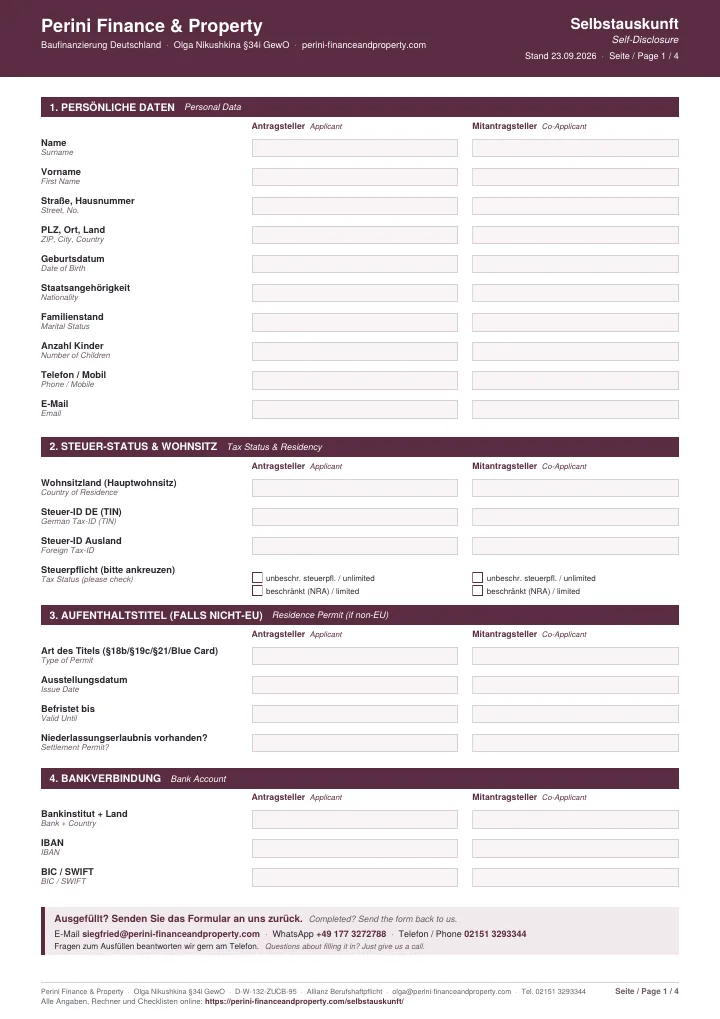
All 13 sections of the self-disclosure
The self-disclosure is the structured overview of income, outgoings, assets and liabilities that a German bank needs to assess a loan. The template is bilingual (DE/EN).
- 650+ Banks compared; §34i Licensed adviser; 2016 Experience since; 89 Published case reports.
- What is the self-disclosure form? The structured overview of your financial situation — income, outgoings, assets and liabilities — that a German bank needs to assess a loan. This template is bilingual (DE/EN), fillable on screen or for printing, and all its sections are set out in full on this page.
- What does it have that a standard German form lacks? Four entries for cases with residence or income abroad: country of residence and tax status (unlimited or limited liability), residence permit with type and expiry, income currency, and property held abroad with value and outstanding balance — otherwise it does not count as equity.
- What do I get, and what does it cost? The self-disclosure form as a fillable PDF (4 pages) plus a separate data-protection consent sheet, straight to your inbox, free — commission, as a rule, from the bank. What our advice costs.
- Who is behind it? Perini Finance & Property — licensed under §34i GewO, 650+ banks compared, we know the banks whose lending rules cover foreign income and several income sources. First consultation free and non-binding.
This is the complete content of the template. Knowing what is asked lets you gather everything once instead of sending three follow-ups — the most common reason a German financing drags on for weeks.
Personal Data (Section 1): Persönliche Daten; Surname; First name; Street and number; Postcode, city, country; Date of birth; Nationality; Marital status; Number of children; Phone / mobile; Email.
Tax Status & Residency (Section 2): Steuer-Status & Wohnsitz; Country of residence; German tax ID (TIN); Foreign tax ID; Tax status: unlimited or limited (NRA).
Residence Permit (if non-EU) (Section 3)
Aufenthaltstitel (falls Nicht-EU); Type of permit (§18b, §19c, §21, Blue Card); Issue date; Valid until; Settlement permit held?
- Bank Account (Section 4): Bankverbindung; Bank and country; IBAN; BIC / SWIFT.
- Current Employment (Section 5): Aktuelle Tätigkeit; Type of employment; Profession; Employed since; Employer and country; Contract: permanent, probation or fixed-term.
- Monthly Income (net) (Section 6): Monatliche Einnahmen (netto); Income currency; Salary (net); Recurring variable income; Self-employment income; Pensions; Rental income (net); Child benefit; Alimony received; Other income.
- Monthly Expenses (Section 7): Monatliche Ausgaben; Housing (rent or mortgage payment); Health insurance; Other insurance; Cost of living; Loans / leasing; Alimony paid; Other expenses.
- Available Equity (Section 8): Verfügbares Vermögen (Eigenkapital); Bank savings; Securities / portfolio (market value); Life insurance (surrender value); Building society savings; Other assets.
- Existing Property (Section 9): Bestehendes Immobilienvermögen; Number of properties; Country / location; Total market value; Total living space; Monthly rental income; Outstanding loan balance; Monthly mortgage payment.
- Other Liabilities (Section 10): Sonstige Verbindlichkeiten; Consumer and instalment loans; Leasing contracts; Guarantees given; Other liabilities.
Consent to data processing (GDPR Article 6, paragraph 1a) (Section 11): Einwilligung; Consent to processing for the purpose of a financing offer; Place, date; Signature of applicant and co-applicant.
Your Financing Project (Section 12): Ihr Vorhaben; Purpose: purchase, new build, refinancing or modernisation; Property address; Property type, year built, living space; Use: owner-occupied or let; Purchase price or building costs; Modernisation / own work; Equity contributed; Loan amount requested; Preferred fixed-rate period.
Additional Details (Section 13): Ergänzende Angaben; Birth name; Place and country of birth; At current address since; Previous address; Matrimonial property regime (e.g. separation of property); Salary payments per year (12, 13 or 14); Side job (type, since, net); Expected retirement date; Existing loans fixed until; Vehicles in household.
Four entries a standard German form does not have
The usual bank forms are cut for domestic cases. Where residence or income sits abroad, they lack exactly the fields the assessment hangs on — and the bank then asks for them one at a time:
Country of residence and tax status — unlimited or limited (NRA) tax liability — this decides which documents are needed (section 2); Residence permit — type, issue date, expiry, settlement permit — the first question for non-EU applicants (section 3); Income currency — a salary in francs, dollars or pounds is assessed differently from euros (section 6); Property held abroad — market value, outstanding balance and payment per property, with country — otherwise it does not count as equity (section 9).
How do you fill in the self-disclosure form for a German bank correctly?
Fill in the self-disclosure form with monthly figures and your documents at hand: net, as it arrives in your account, complete on instalments and only with assets you can prove. The bank checks every figure against the documents.
Two columns — Only someone who co-signs the loan fills in the second column — for couples buying together, both. Sections 1 to 4: personal details — As in your passport or ID; non-EU nationals add the residence permit with its expiry (section 3). Section 5: employment — Tick probation or a fixed term as it is — the bank sees it in the employment contract anyway. Section 6: income — Net amounts per month; variable income only if it is paid regularly.
How many salaries are paid per year goes into section 13. Section 7: expenses — All current instalments, including leasing and loans that continue.
Undisclosed instalments show up in the credit report anyway. Sections 8 to 10: assets and liabilities — Only amounts a document shows; bank statements no more than four weeks old.
With several properties, add the assets and liabilities statement. Section 11: consent — Place, date and the signature of every applicant — without a signature the form is incomplete. Section 12: your project — Purchase price without ancillary costs, plus the equity you contribute; the ancillary costs are usually paid from it.
Section 13: additional details — Birth name, previous address, matrimonial property regime and the number of salaries per year — details the bank would otherwise ask for one by one. Then — Save, sign and send it back: by e-mail to siegfried@perini-financeandproperty.com, via WhatsApp or by phone on +49 2151 3293344.
Want to fill it in together?
If you have questions about individual fields — especially with foreign income or several income sources — We’re happy to help directly. First consultation free and non-binding.
What this template doesn't replace: The self-disclosure form is a working template, not legal or tax advice. Mortgage brokerage under the German §34i GewO licence (Olga Nikushkina).
Frequently asked questions
Is there a self-disclosure template for a German mortgage?
Yes — all 80 fields from 13 sections are set out in full on this page. The bilingual (DE/EN) version, fillable on screen and with special fields for non-residents (country of residence, tax status, residence permit, income currency), is free by email further down this page.
Who has to fill in the second column of the self-disclosure form?
Only someone who co-signs the loan fills in the second column. For couples buying together, both fill it in.
Does property held abroad count as equity in the self-disclosure form for a German bank?
Property held abroad is entered in section 9 with market value, outstanding balance and payment per property, with country. Otherwise it does not count as equity.
Any questions on this topic?
A first consultation is free and without obligation — the commission is, as a rule, paid by the bank. We tell you what this means for your own financing.
Related pages
What happens after the self-disclosure form?
Mortgage process in Germany: usually 3 to 10 working days from a complete file to approval — and what slows it down for non-residents.
What our advice costs
Independent mortgage advisor in Germany: as a rule the lending bank pays the commission, not you — and if no financing comes about, you owe nothing.
assets and liabilities statement
Assets and liabilities statement (DE/EN): free bilingual template, fillable on screen — real estate, other liabilities and other assets for your bank.
Mortgage advice for Germany: which route fits if your residence or income is abroad?
Advice costs you nothing; we are as a rule paid by the financing bank. Brokerage of consumer mortgage loans under §34i GewO by Olga Nikushkina.
Mortgage documents for Germany: which papers does the bank want to see?
Non-resident taxpayers and expats additionally need their residence permit, details of income in a foreign currency and documents on limited tax liability.
Mortgage document checklist Germany (PDF): which real estate documents does every bank want?
The person first, then the money, then the property: ID and registration, proof of income, equity and existing loans, then the property documents.

Editorially responsible: Olga Nikushkina — owner, §34i GewO (German mortgage brokerage), adviser register D-W-132-ZUCB-95. Specialised in German property financing with an international dimension: non-residents, foreign-currency income, cross-border workers, expats. Siegfried Perini is entered in the German intermediary register under this licence as a person directly involved in brokerage and advice (§ 11a GewO), active in real estate since 1992. Not legal or tax advice.