Apply for a KfW loan: 297 for new builds, 261 for renovation or funding 159 – which route fits?
Two completely different funding logics, one starting point: if you build new or buy for the first time, you work with interest-subsidised KfW loans. If you renovate an existing building, you combine BAFA grants, KfW loans and the tax route under § 35c EStG. Here you can find out in under a minute which of the two routes fits your project.
Applying for a KfW loan: how does it work for a new build or a renovation, and what can be combined?
You apply for a KfW loan through an on-lending bank or savings bank (Sparkasse), and you must do so before any legally binding purchase, construction or renovation contract; a retrospective application is ruled out. Housing subsidies from the federal states (Wohnraumförderung der Länder) can generally be combined with KfW loans. For the same measure, a grant and the tax bonus under § 35c EStG are mutually exclusive. You can find all KfW programmes in the original at kfw.de.
State loan plus KfW: ranking behind, lowers the loan-to-value ratio
In principle, the housing subsidies of the federal states can be combined with KfW loans — the state loan usually ranks behind the first-ranking charge and so lowers the loan-to-value ratio of the main loan. How much it brings depends on the federal state: Hamburg (IFB) grants up to €150,000, ranking behind, at 2% interest; Lower Saxony (NBank) grants up to €200,000 interest-free for the first 20 years, plus a €10,000 grant per child. Housing subsidies of the federal states.
Where do I apply for a KfW loan and a BAFA grant?
Not directly with the development bank: KfW loans go through an on-lending bank or savings bank, BAFA grants directly through the BAFA online portal. The order is decisive — the funding application must be submitted before a legally binding purchase, construction or renovation contract; a retrospective application is ruled out.
Can I combine a grant and the tax bonus for the same measure?
No. For the same measure, a funding grant and the tax bonus under § 35c EStG are mutually exclusive — it is either one route or the other.
Which project applies to you?
Different subsidies fit depending on the project: for new builds and first-time purchases KfW 297, 298 and 300; for renovation and existing buildings BAFA grants, KfW loans or the tax route under § 35c EStG.
New-build funding
KfW 297 and KfW 298 (Climate-friendly New Build, Klimafreundlicher Neubau) and KfW 300 (Home Ownership for Families) — interest-subsidised loans for building and first-time purchases.
Renovation funding
BAFA grants, KfW loans for heating and the building envelope, or the tax route under § 35c EStG — depending on the property and your tax situation.
The programmes at a glance
RechtsquelleAll values maintained and checked on 21.09.2026. Source: BEG funding guidelines for residential buildings (BEG WG) and individual measures (BEG EM), BMWE, valid from 21.07.2026, published on 20.07.2026 on energiewechsel.de; KfW overview page ‘Anpassungen 2026’ (adjustments 2026); KfW press release of 08.07.2026
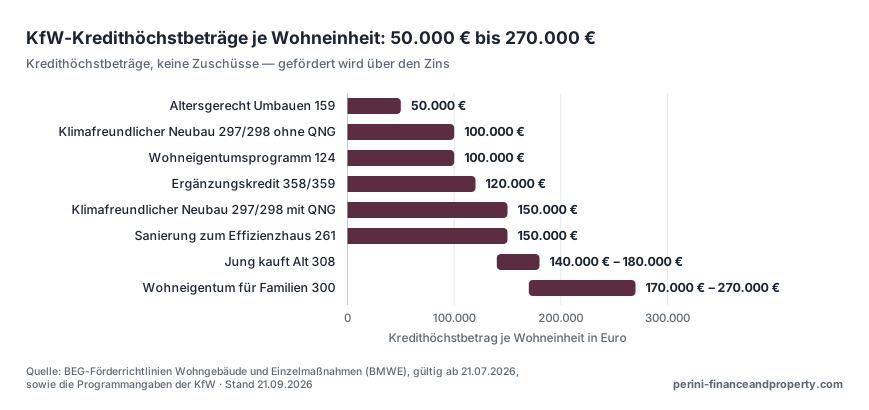
The largest credit limit per residential unit is carried by Home Ownership for Families 300 at €170,000 – €270,000, the smallest by Age-appropriate Conversion 159 at €50,000. The amounts are maximum loan amounts, not grants: the funding comes through the interest rate; a repayment grant is only contained in the renovation programmes. Where the chart shows a range, the number of children or the funding level decides the amount — the upper value always requires all conditions to be met in full and is not the norm. Several programmes can be combined; what is promised is what KfW approves in the individual case.
Source: BEG funding guidelines for residential buildings and individual measures (BMWE), valid from 21.07.2026, and the programme details of KfW · As of 21.09.2026
| Programme | What for | Maximum amount |
|---|---|---|
| KfW 297/298 | Climate-friendly new build, with and without QNG seal | €150,000 with QNG, €100,000 without |
| KfW 300 | Home ownership for families, new build for owner-occupation | €170,000 to €270,000 |
| KfW 308 | Jung kauft Alt: purchase of an existing building with an obligation to renovate | €140,000 to €180,000 depending on the number of children |
| KfW 261 | Energy-efficient renovation to Efficiency House (Effizienzhaus) standard | €150,000 |
| KfW 124 | Home Ownership Programme (Wohneigentumsprogramm), purchase and construction for owner-occupation | €100,000 |
| KfW 159 | Age-appropriate conversion and burglary protection | €50,000 |
| KfW 458 (heating) | Grant for replacing the heating system | Basic funding 30%, funding rate 70% (80% with taxable income (zvE) up to €30,000, with family supplement up to €40,000) |
| KfW 358 / 359 | Supplementary loan (Ergänzungskredit) to the grant funding | €120,000 per residential unit, in addition to the grant funding promised |
| § 35c EStG | Tax bonus for energy-efficiency measures, alternative to funding | 20% over three years, at most €40,000 |
Two points that are not apparent from the table. First, the maximum amounts are upper limits per residential unit or per property, not commitments — what is actually approved depends on the standard achieved and on the income limit, for KfW 300 for example €90,000 taxable household income with one child. Second, a grant and the tax bonus are mutually exclusive for the same measure: the tax bonus applies solely as an alternative and cannot be combined with BAFA or KfW funding for the same measure. The binding tax assessment is made by the tax adviser.
The BEG changeover has applied since 21.07.2026; applications up to 20.07.2026 still run under the old conditions. For KfW 308, the new scale has applied since 03.08.2026 — the amount depends on the number of children. As an example, the calculator assumes one child. The decisive date is the day the application is received by KfW.
Funding calculator
Before you work your way through programme names and conditions: based on a few details about the property and the project, the funding calculator shows which KfW and BAFA programmes are generally eligible.
Jung kauft Alt — individual measures check
Windows, façade, roof or heating: is it enough for KfW 308?
What matters in a funding application?
KfW development loans and BAFA grants are not applied for directly with the development bank, but through a bank or savings bank that passes the funds on, or — in the case of BAFA — directly through the BAFA online portal itself. For the KfW programmes, the order is decisive: the funding application must be submitted before a legally binding purchase, construction or renovation contract is concluded; a retrospective application is generally ruled out.
Anyone who signs the construction contract first and only thinks about funding afterwards has, as a rule, already lost the opportunity. A comparable logic applies to BAFA grants for individual measures, albeit with partly different deadlines depending on the programme. Not every bank handles every funding programme with the same routine — in practice, the quality of processing differs noticeably between institutions.
Anyone who wants to use a funding programme should therefore already make sure, when choosing the financing bank, that it actively offers the programme in question and has experience with it. Whether a KfW loan, a BAFA grant or a combination of both routes makes sense in the end depends on the specific project and is best clarified in the initial consultation, not by an online calculator alone.
Funding is only one building block of the financing
A KfW loan or BAFA grant alone does not finance a construction project — it has to be fitted into the overall financing, together with bank loans and equity. This interlinking is exactly our work: access to over 650 banks, a licence under § 34i GewO, and a view of the overall picture rather than just the individual funding programme.
Although the interest conditions of development loans are usually below market level, the maximum loan volume per programme is capped and is not sufficient on its own for larger projects. If the funding is considered in isolation, without fitting it into the overall financing, you can easily end up with two separate loan agreements with different fixed-rate periods and repayment structures, which develop differently at the end of each fixed-rate period — a coordination effort that can be avoided with planning that is integrated from the start.
Book an appointmentWhatsApp message to SiegfriedFrequently asked questions
KfW loan for families: how large is the credit limit for Home Ownership for Families?
Home Ownership for Families (Wohneigentum für Familien, KfW 300) carries the largest credit limit, at €170,000 to €270,000 per residential unit. Where a range is given, the number of children or the funding level decides; the upper value requires all conditions to be met in full and is not the norm. These are maximum loan amounts, not grants.
KfW funding 159: what does the Age-appropriate Conversion programme fund?
The programme (Altersgerecht Umbauen) funds age-appropriate conversion and burglary protection with a loan of up to €50,000. That is the smallest credit limit in the overview. The funding comes through the interest rate; the amount is a maximum loan amount, not a grant.
Which state home ownership funding can I combine with KfW, and how much does it bring?
In principle, yes — KfW loans and the housing subsidies of the federal states do not rule each other out; the state loan usually even ranks behind the first-ranking charge and thereby lowers the loan-to-value ratio (Beleihungsauslauf) of the main loan.
How much this brings in concrete terms, however, depends on the federal state and is not a single uniform figure: Hamburg grants up to €150,000 through the IFB, ranking behind, at 2% interest; Lower Saxony grants up to €200,000 through the NBank, interest-free for the first 20 years, plus a €10,000 grant per child. The amounts that apply in your federal state and the rule for combining them with KfW are on the respective state page: Housing subsidies of the federal states.
Let’s talk about your financing
Send us a WhatsApp message or book a 30-minute call. The initial review is free of charge.
Related pages
KfW 300 Home Ownership for Families: who gets the loan and how much?
Families with a child under 18 receive the KfW loan 300 for a climate-friendly new build (Efficiency House 40), from €170,000 to €270,000 depending on the number of children.
BEG funding 2026 and KfW loans: which programme fits your project as an owner-occupier?
It is available free of charge as a PDF by email. If none of the programmes fits, the tax bonus under § 35c EStG remains: 20% of the costs over three years.
Mortgage with KfW 2026: which programmes are there and how much do they offer?
For a mortgage with KfW, eight programmes cover the field in 2026. For a purchase without conditions, the Home Ownership Programme 124 (up to €100,000).

Editorially responsible: Olga Nikushkina — owner, §34i GewO (German mortgage brokerage), adviser register D-W-132-ZUCB-95. Specialised in German property financing with an international dimension: non-residents, foreign-currency income, cross-border workers, expats. Siegfried Perini is entered in the German intermediary register under this licence as a person directly involved in brokerage and advice (§ 11a GewO), active in real estate since 1992. Not legal or tax advice.