Mortgage documents required in Germany: property and purchase checklist as a PDF
A missing document causes delays far more often than the credit decision itself. This checklist lists all 58 documents in the order a German lender needs them.
What mortgage documents are required for a property purchase in Germany? The checklist covers borrower, income, equity and property records. Prepare the documents in the lender’s order so missing evidence can be identified before the formal application.
Which documents does a German mortgage file need?
The person first, then the money, then the property: ID and registration, proof of income, equity and existing loans, then the property documents.
The Germany mortgage checklist (PDF, 9 pages, German and English) lists all 58 documents — for employees, civil servants, pensioners and the self-employed living in Germany.
How to get the checklist: open the PDF or receive it by email
- Mortgage checklist Germany · 58 documents, German and English, to tick off
- By email · as an attachment, ready to use
Request by email: Mortgage checklist Germany (PDF, 9 pages) (Dutch (Germany) · French (Germany))
Request the checklist
Free · 30 seconds · no sales pressure
We use your email address to send the files you request. If needed, we may contact you personally about your request.
What are the eight categories in the mortgage checklist?
The checklist organises all 58 documents into eight groups: identification, proof of income, assets and equity, existing liabilities, self-employed and freelancers, property documents, letting, and refinancing and transfer.
- What’s in the checklist? All 58 documents organised by category, the deadlines, a sheet for your capital requirements, the purchase costs by federal state, a sample calculation and the five most costly mistakes.
- Why German and English? Each document is named in both languages, so you can recognise the German names when obtaining the paperwork.
- Is the checklist free? Yes. Open the PDF directly without a form or ask to receive it by email.
- Identification (1): Identity card (Personalausweis) or passport, certificate of residence; for non-EU citizens, a residence permit; where applicable, a marriage contract, divorce decree or separation agreement.
- Proof of income (2): The last three payslips plus the December payslip from the previous year, annual wage tax certificate (Lohnsteuerbescheinigung), employment contract, income tax assessment; for civil servants, pensioners and parents, the relevant statements.
- Assets and equity (3): Bank and investment account statements, building society savings contract (Bausparvertrag), surrender value of life insurance (Lebensversicherung) policy, gift declaration if the equity comes from within the family.
- Existing liabilities (4): Loan and lease agreements with current balances, guarantees, other property loans, maintenance orders.
- Self-employed persons and freelancers (5): Tax assessment notices and balance sheets or simplified accounting records for the last three years, current business analysis, business registration; for shareholders, the articles of association (Gesellschaftsvertrag) and an extract from the commercial register (Handelsregisterauszug).
- Property documentation (6): Draft sale agreement, land registry extract (Grundbuchauszug), cadastral map, living space calculation, floor plans, photographs, energy performance certificate (Energieausweis) — once the property has been found.
- For letting (7): tenancy agreements and rent receipts for the last three months; for new-build properties, the expected rent based on the rent index. The summary for this: Rent roll.
Refinancing and transfer (8): The existing loan agreement (Darlehensvertrag) and the most recent annual account statements from the current bank.
Real-estate documents in Germany: Which ones expire?
A document that is out of date counts as a missing one. Five documents expire: Proof of equity — account and portfolio statements no more than four weeks old; Land-register extract — no more than three months old; Payslips — the last three plus the prior-year December payslip; Self-employed — current BWA with trial balance, from July also the annual accounts; KfW subsidy — the application must precede the start of the project.
An outdated document counts as a missing one. Pay particular attention to the deadlines for these five documents:
Proof of equity — account and portfolio statements no more than four weeks old; Land-register extract — no more than three months old; Payslips — the last three plus the prior-year December payslip; Self-employed — current BWA with trial balance, from July also the annual accounts; KfW subsidy — the application must precede the start of the project.
The most expensive deadline is the last one: the start of the project is deemed to be the moment a supply or service contract attributable to it is concluded. Sign first, apply later — and the cheapest part of the whole financing is gone for good.
| Document | Why |
|---|---|
| Proof of equity | the lender wants today’s balance, not last quarter’s |
| Land-register extract | encumbrances change the valuation |
| Payslips | the December payslip shows the annual total including bonuses |
| Annual accounts, self-employed | from mid-year the interim report alone is no longer enough |
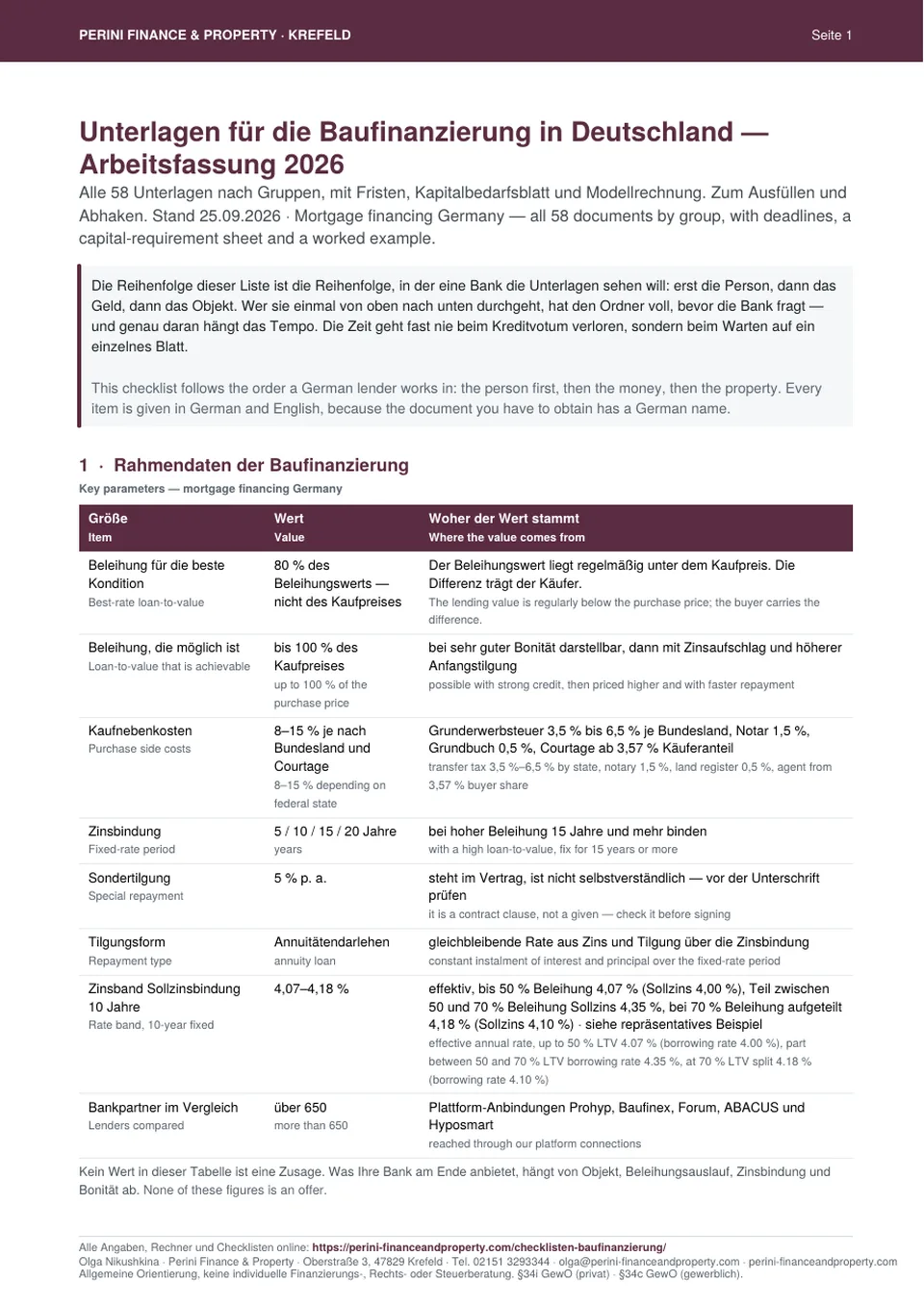
Which key parameters apply to mortgage financing in Germany?
Above all the loan-to-value: the best rate applies up to 60 % of the lending value, not of the purchase price. None of these figures is an offer.
Your final terms depend on the property, loan-to-value ratio, fixed-rate period and credit standing.
| Item | Value | Where the value comes from |
|---|---|---|
| Best-rate loan-to-value | 60 % of the lending value — not of the purchase price | Up to 60 % the lowest rate of the rate band applies. The lending value is regularly below the purchase price; the buyer carries the difference. |
| Loan-to-value that is achievable | up to 100 % of the purchase price | possible with strong credit, then priced higher and with faster repayment |
| Rate band, 10 years fixed (as at 13 November 2026) | 3.90 % nominal (3.97 % effective) up to 60 % loan-to-value; 4.15 % (4.23 % effective) on the part between 60 and 70 % | at 70 % together 3.94 % (4.01 % effective); above 70 % we calculate the rate case by case; Perini’s own bank survey, not an offer |
| Purchase side costs | 8–15 % depending on federal state and agent’s fee | transfer tax 3.5 %–6.5 % by state, notary 1.5 %, land register 0.5 %, agent from 3.57 % buyer share |
| Fixed-rate period | 5 / 10 / 15 / 20 years | with a high loan-to-value, fix for 15 years or more |
| Special repayment | 5 % p. a. | it is a contract clause, not a given — check it before signing |
| Repayment type | annuity loan | constant instalment of interest and principal over the fixed-rate period |
| Lenders compared | more than 650 | reached through our platform connections |
Representative example under § 17 PAngV (German price-indication rules)
This page quotes a borrowing rate and a monthly instalment. Anyone who advertises figures relating to the cost of a consumer real-estate loan must state a representative example. Here it is — it is neither an offer nor a commitment.
Annuity loan with monthly payments and no arrangement fee. The total amount payable includes the instalments during the fixed-rate period plus the balance remaining at its end.
Fixed-rate period 10 years, 2 % initial repayment, loan-to-value measured against the lending value. The rate in an individual case depends on the property, the loan-to-value and your credit standing; above 70 % loan-to-value and for other fixed-rate periods we calculate the rate case by case.
Source: Perini’s own bank survey, as at 13 November 2026. This is neither an offer nor a financing commitment — the rate you are offered depends on the bank, the property, the loan-to-value and your credit standing.
| Item | Value |
|---|---|
| Net loan amount | €350,000 |
| Loan-to-value | 60 % of the lending value |
| Fixed-rate period | 10 years |
| Fixed borrowing rate | 3.90 % p.a., fixed (up to 60 % loan-to-value) |
| Initial repayment rate | 2.0 % initially |
| Monthly instalment | €1,720.83 per month |
| Effective annual rate | 3.97 % p.a. |
| Balance at the end of the fixed-rate period | €264,556.14 |
| Total amount payable | €471,055.74 |
| Data as at | 13 November 2026 |
| Loan intermediary | Perini Finance & Property, Olga Nikushkina, Oberstraße 3, 47829 Krefeld, Germany |
| Model loan term | 10 years |
| Payment schedule | 120 monthly instalments, plus a final payment of €264,556.14 at maturity |
| Security | Mortgage charge on the financed property |
Which official property documents does the bank need?
The bank needs a land register extract, cadastral map, dimensioned plans from the building file, a floor-area calculation and an energy certificate. Sales brochure details do not replace these official documents. Missing documents or incorrect formats delay both the valuation and approval.
Land register extract (Grundbuchauszug) — complete and no more than three months old; if section 2 lists rights such as a right of residence, usufruct, right of way or utility easement, the bank also needs the deeds behind them.
Right of way — if the plot has no direct access to a public road, a right of way must be registered in the land register — no bank accepts an alleged customary right;
Cadastral map (Flurkarte) — the official map; if a building or extension is not shown on it, the bank will ask whether it was ever approved; Floor plans, sections, elevations — dimensioned, from the building file and stamped by the architect; many banks do not accept self-drawn plans.
Getting the building file from the building authority can take several weeks; Floor-area calculation — some banks want it stamped and signed by an architect; Modernisations — a list of past modernisations with year and cost — it extends the remaining useful life the bank works with and so raises the bank value;
Apartment — declaration of division (Teilungserklärung) with all amendments, the division plan and the certificate of self-containment; missing plans are available from the land registry.
Register of building encumbrances (Baulastverzeichnis) — an extract from the building authority; Bavaria has no such register, restrictions there are entered in the land register.
Energy certificate — banks now ask for it on every loan, including follow-up financing; either the consumption-based or the demand-based certificate is accepted.
See how these documents support the bank’s valuation in bank value explained.
How much do side costs differ between federal states?
On a €400,000 purchase price, the same property costs €12,000 more in side costs in the most expensive federal state than in the cheapest.
Worked example with assumed inputs, not an offer.
Same property, same price, €12,000 apart — purely because of the federal state.
| Item | Bavaria | North Rhine-Westphalia | Difference |
|---|---|---|---|
| Purchase price | €400,000 | €400,000 | — |
| Transfer tax | 3.5 % | 6.5 % | 3 percentage points |
| Notary and land register | 2 % | 2 % | — |
| Side costs without agent | €22,000 | €34,000 | €12,000 |
| Side costs incl. agent | €36,280 | €48,280 | €12,000 |
How long does mortgage approval in Germany take?
The range of 3 to 10 working days applies to approval once all documents have been received.
| Step | What happens | Time |
|---|---|---|
| First call | feasibility, choice of lender, eligibility — free of charge | one appointment |
| Documents | you supply, we sort and check before submission | your pace |
| Lender selection and application | parallel comparison across 650+ banks; KfW and state programmes run through the financing bank | a few days |
| Approval | binding offer once the documents are complete | usually 3 to 10 working days |
| Notarisation and disbursement | notary appointment, land charge, disbursement | after approval |
Which checklist suits your circumstances?
Living abroad: the non-resident checklist.
Doctors: the checklist for doctors.
Developers: the project finance checklist.
The forms: self-disclosure, assets and liabilities statement and rent roll.
How we support your German mortgage: We compare 650+ banks in parallel and check your self-disclosure before submission. We clarify subsidy eligibility before the first signature and support you through the notary appointment, disbursement and follow-up financing.
What are the limits of this checklist?
The checklist provides general guidance. It does not replace individual financing, legal or tax advice.
Consumer property loans are arranged under the licence pursuant to §34i GewO (Olga Nikushkina).
Frequently asked questions
Which mortgage documents are required by a German bank?
Documents on the person, the income, assets and liabilities and the property — 58 items in eight groups, of which only those that apply to your case count. The full list is in the checklist PDF (9 pages) (Dutch (Germany) · French (Germany)).
How old may the documents be?
Account and portfolio statements as proof of equity no more than four weeks, the land-register extract no more than three months. Plus the last three payslips and the prior-year December payslip; for the self-employed, from July also the annual accounts.
What else do the self-employed need?
Tax assessment notices and balance sheets or profit and loss accounts for the last three years, a current business analysis report including a trial balance, and the business registration certificate; for shareholders, the articles of association (Gesellschaftsvertrag) and an extract from the commercial register (Handelsregisterauszug).
Checklist of documents for property financing as a PDF: is the list available to download free of charge?
Yes, the checklist costs nothing. You can open the PDF directly without a form or receive it by email. It lists all 58 documents, on 9 pages, in German and English.
Who does this checklist apply to?
To employees, civil servants, pensioners and self-employed people with residence in Germany. For residence abroad, the checklist for tax non-residents applies, and for doctors the checklist for doctors.
Which documents do I need for buying a house and financing?
The documents for buying a house fall into two groups: documents on the person (ID, evidence of income and equity) and property documents (draft purchase contract, land register extract no more than three months old, cadastral map, energy certificate). The bank checks which documents it needs before the commitment. All 58 are in the list above.
Documents for buying a house, notary: what must be available?
Before the notary appointment you need the draft purchase contract, a current land register extract and the cadastral map. Which other documents are needed when buying a house is shown in the list above.
Any questions on this topic?
A first consultation is free and without obligation — the commission is, as a rule, paid by the bank. We tell you what this means for your own financing.
For a property loan, most banks only arrive at a workable calculation from a household net income of around €3,500 a month — for couples, the joint income counts.
Bring the available property, income and deposit documents from the checklist. We can tell you what needs to be ready before the lender reviews your property purchase.
Related pages
Rent roll
Rent roll template for the bank: details for each rental unit – tenant, floor area, basic rent, service charges and stepped rent — editable in German and English, available free of charge as a PDF.
bank value explained
Property valuation by German banks: why the bank value sits below the purchase price, what CRR III changed and what is negotiable. Free briefing note.
Confirmation of funding
Confirmation of financing when buying a house: a written assessment of feasibility for estate agents and sellers — free of charge, with no credit check and no formal commitment from a bank.
checklist for doctors
Mortgage income requirements for doctors: the documents banks require by career stage, including practice purchase and cases abroad. Free checklist.

Editorially responsible: Olga Nikushkina — owner, §34i GewO (German mortgage brokerage), adviser register D-W-132-ZUCB-95. Specialised in German property financing with an international dimension: non-residents, foreign-currency income, cross-border workers, expats. Siegfried Perini is entered in the German intermediary register under this licence as a person directly involved in brokerage and advice (§ 11a GewO), active in real estate since 1992. Not legal or tax advice.