Commercial assets and liabilities statement: template and sample for your company
For a GmbH, property developer or holding company, the bank needs a clear overview of the company’s position. Use the bilingual fillable PDF template to prepare it.
What goes into a company's assets and liabilities statement for a German bank?
The bank wants everything on one sheet for a company: the company and its shareholders, every property with rent, debt and value, other liabilities and holdings, and the key figures of the project. The fillable bilingual template is free here as a PDF.
How to download the commercial statement or receive it by email
- Commercial statement DE/EN · bilingual, fill in on screen or print
- By email · as an attachment, ready to use
Request by email: Commercial assets & liabilities statement DE/EN (PDF, 2 pages) (Dutch (commercieel))
Request the commercial statement
Free · 30 seconds · no sales pressure
We use your email address to send the files you request. If needed, we may contact you personally about your request.
How are the four parts of the template organised?
Begin with the company details. Part A covers properties, Part B other liabilities including contingent ones, and Part C assets and holdings. Part D contains the key figures, followed by the exit strategy.
- What if you are not a company? For private individuals, there is the private assets and liabilities statement.
- What does the commercial version add? Company details, the remaining term of liabilities, shareholdings, commercial key figures, an exit strategy and a field for the tax adviser.
- Is the template free? Yes. Open the PDF directly without a form or receive it by email.
- Who is financing? (Company): Company or name, legal form, commercial register (Handelsregister) number, year of incorporation, shareholders with their shares, and management.
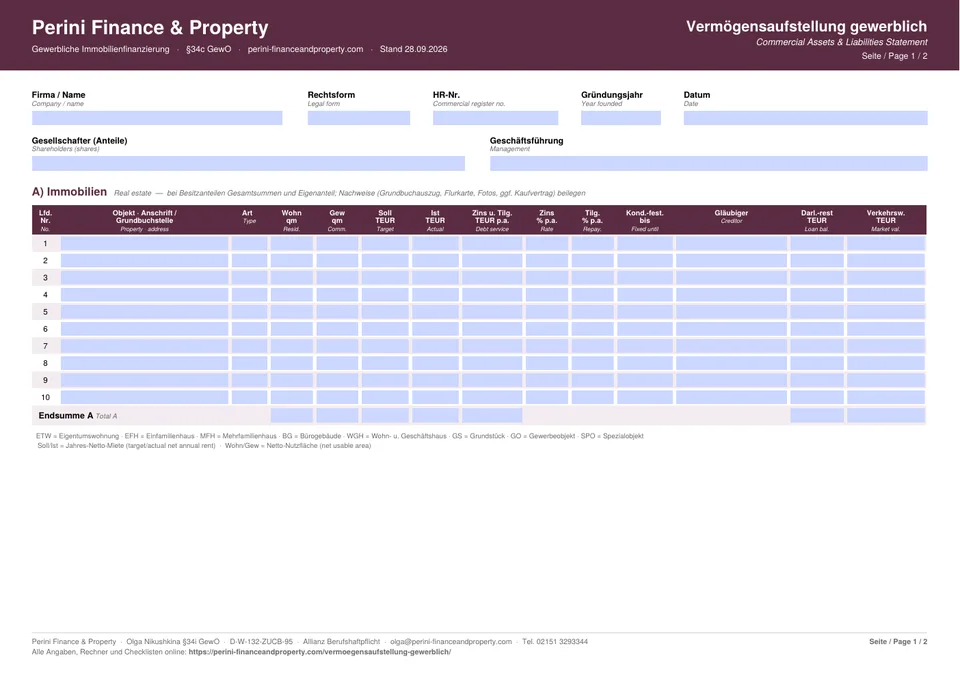
- Property (Part A): Ten lines, one per property. For partial ownership, total amounts and own share. Property, address and land register reference (Grundbuchstelle); type of use; residential and commercial floor area in m²; target and actual annual net rent; interest and repayment p. a., interest rate, repayment rate; fixed rate until, creditor; outstanding loan balance and market value.
- Other liabilities (Part B): Including guarantees, rent guarantees and leasing. Creditor and amount; interest and repayment p. a.; purpose; remaining term.
- Assets and shareholdings (Part C): Enclose account and securities account statements, articles of association or valuation reports (Wertgutachten). Item and owner; bank or type; description and value.
- Key figures (Part D): For each project or existing property, from the profitability calculation. Loan-to-cost and loan-to-value; equity ratio; debt service capacity; pre-sale or pre-letting rate; expected project margin.
Where do you enter the key figures for the bank’s assessment?
Part D brings together the bank’s project assessment criteria. Take the figures from your profitability analysis and set them out clearly before applying.
Loan-to-Cost (LTC) — borrowed capital divided by the total cost of the project.
Loan-to-Value (LTV) — borrowed capital divided by the market value.
Equity ratio — proportion of own funds in the total costs.
Debt-servicing capacity — net rental income in relation to interest and capital repayments.
Pre-sale or pre-letting rate — the proportion of a project that has already been sold or let.
Project margin — expected profit as a percentage or in TEUR.
See the Project Financing Checklist for the additional documents your project needs.
Which fields do Parts A and B contain?
Part A has ten rows, one per property, with net annual rent target and actual, interest and repayment, creditor, loan balance and market value. Part B lists other liabilities including guarantees, rent guarantees and leasing, with their remaining term.
Real estate (Part A): Ten lines, one per property; for part-ownership totals and own share.
- Property, address and land register
- Type of use
- Residential and commercial area in m²
- Net annual rent, target and actual
- Interest and repayment p.a., rates
- Fixed until, creditor
- Loan balance and market value.
Other liabilities (Part B):
- Including guarantees, rent guarantees and leasing.
- Creditor and amount
- Interest and repayment p.a.
- Purpose
- Remaining term.
In which order should you complete the commercial statement?
Start with the company details. Complete Part A for properties, Part B for liabilities including contingent ones, and Part C for bank balances, securities accounts and shareholdings. Then add Part D and the exit strategy.
Company details first — Company name, legal form and commercial register (Handelsregister) details as per the current extract from the register (Registerauszug).
Part A — One row per property; target and actual annual net rent shown separately so that vacancies are visible.
Part B — Include contingent liabilities: sureties, rent guarantees, leases — with remaining term.
Part C — Bank balances, securities accounts, equity interests in other companies with a value.
Part D and Exit — Key figures from the profitability analysis and, in two sentences, how the project will conclude: sale, letting or follow-up financing.
Conclusion — Date, signature and stamp; for larger financing arrangements, the tax adviser’s certification.
Which fields do Parts C and D contain?
Part C lists bank balances, custody accounts and holdings, with account and portfolio statements attached. Part D sets out the key figures per project, such as loan-to-cost, loan-to-value, equity ratio and debt service coverage.
Assets and holdings (Part C): Attach account and portfolio statements, articles or valuations.
- Item and holder
- Bank or type
- Description and value.
Key figures (Part D): Per project or property, from the feasibility calculation.
- Loan-to-cost and loan-to-value
- Equity ratio
- Debt service coverage
- Pre-sale or pre-let ratio
- Expected project margin.
Which supporting documents should you prepare?
For let properties, the rent roll per unit; for property developers, the project finance checklist; for private individuals, the private assets and liabilities statement. Commercial financing at a glance: Commercial and property developers.
Consumer property loans (Immobiliar-Verbraucherdarlehen) are brokered under Section 34i of the Trade Regulation Act (GewO), commercial loans under Section 34c GewO (Olga Nikushkina).
Which company details should you enter first?
Use the company name, legal form and commercial register (Handelsregister) details shown in the current register extract (Registerauszug).
Enter each property on its own row in Part A, with target and actual annual net rent separated to reveal vacancies.
Part B also records contingent liabilities and remaining terms.
Part C shows balances, deposits and shareholdings with their values.
Part D sets out the key figures and a two-sentence exit strategy.
Finish with date, signature and stamp.
Frequently asked questions
Is there a template for a company assets and liabilities statement?
Yes. The bilingual commercial statement (German/English) is available on this page as a fillable PDF (2 pages) (Dutch (commercieel)), free — with company details, property, liabilities, holdings and key figures.
How does it differ from the private statement?
It starts with the company (name, legal form, commercial register, shareholders, management), asks for the remaining term of liabilities, records holdings and ends with the key figures of the project and the exit strategy.
Who certifies it?
The company confirms it with date, signature and stamp. For larger loans, banks also require certification by a tax adviser or auditor. The template includes the relevant field.
Template for a private statement of assets: How does the commercial version differ from the private one?
The commercial version additionally contains company data, the remaining term of the liabilities, shareholdings, commercial key figures, an exit concept and a field for the tax adviser. It is intended for GmbH and GmbH & Co. KG, developers, portfolio holders and property-holding companies. For private individuals there is the private statement of assets.
Any questions on this topic?
A first consultation is free and without obligation — the commission is, as a rule, paid by the bank. We tell you what this means for your own financing.
For a property loan, most banks only arrive at a workable calculation from a household net income of around €3,500 a month — for couples, the joint income counts.
For business borrowing, share a summary of existing assets, liabilities and payments, with the purpose and amount of the new loan. We can identify which figures a lender would ask you to support.
Related pages
private statement
Assets and liabilities statement (DE/EN): free bilingual template, fillable on screen — real estate, other liabilities and other assets for your bank.
project finance checklist
Project finance checklist for developers: all 20 documents and the metrics (LTC, LTV, equity ratio) that banks and debt funds check — free as a PDF.
rent roll
Rent roll template for a German bank: tenant, area, net rent, service charges and stepped rent per unit — bilingual, fillable, free PDF.

Editorially responsible: Olga Nikushkina — owner, §34i GewO (German mortgage brokerage), adviser register D-W-132-ZUCB-95. Specialised in German property financing with an international dimension: non-residents, foreign-currency income, cross-border workers, expats. Siegfried Perini is entered in the German intermediary register under this licence as a person directly involved in brokerage and advice (§ 11a GewO), active in real estate since 1992. Not legal or tax advice.